The Risk Compass is our new tool to map structural risks, including inflation.
Falling rates masked inflation risk for the past 40 years.
From 1981 through 2020, interest rates trended lower:
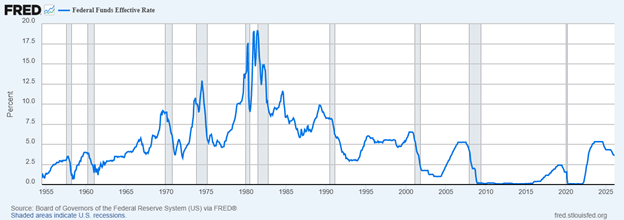
Federal Funds Rate (1980–Present)
Entire advisory careers were built in a falling-rate regime.
Portfolio construction evolved accordingly.
Inflation was treated as cyclical.
Temporary.
Manageable.
The inflation regime has returned.
A REGIME CHANGE
For four decades, disinflation shaped markets and portfolios.
It rewarded leverage.
It rewarded duration.
It rewarded financial assets.
That tailwind is gone.
Debt levels are higher than ever.
Deficits are structural, not temporary.
Government debt issuance is rising.
The system is built to expand.
STRUCTURAL INCENTIVES
Inflation is structural.
It’s built into the system.
Policy makers operate inside a debt-based system.
In that system, inflation reduces the real burden of debt.
Deflation increases it.
Expecting zero inflation from a debt-heavy system is unrealistic.
Debt compounds.
Principal and interest must be serviced.
That requires more currency units over time.
Political systems reward spending.
They rarely reward restraint.
Deficits are easier than discipline.
Structural incentives favor expansion.
Expansion favors inflation.
THE DEFINITION PROBLEM
The definition of inflation is unsettled.
Some describe inflation as rising prices.
Others point to economic growth.
Our view is simpler.
Inflation begins with the expansion of currency units.
Prices are the result.
When definitions shift, accountability shifts.
Without a clear definition, inflation is easier to tolerate and harder to confront.
A NEW LENS
Inflation is an increase in currency units.
When currency units expand, each existing unit buys less.
Inflation destroys purchasing power.
INFLATION AS POLICY
A 2% inflation target guarantees long-term currency erosion.
Small numbers compound.
Inflation is not an accident of the system.
It is a feature.
This is a managed decline.
THE HOODWINK
The public narrative says 2% inflation equals stable prices.
It does not.
2% inflation is still inflation.
Stable prices are flat.
Calling inflation “price stability” is a framing choice.
This is narrative control.
This is spin.
THE CPI
The Consumer Price Index is the most widely cited inflation gauge.
But CPI methodology has changed repeatedly over the decades.
Substitution.
Hedonics.
Owner’s Equivalent Rent.
Each adjustment tends to reduce reported inflation.
Asset prices are excluded entirely.
Assets are prices too.
Bad data leads to bad decisions.
THE BLIND SPOT
Most RIA models are built around assets under management.
Some of the most effective inflation hedges – physical precious metals, certain hard assets, and assets held outside traditional custodial structures – do not always sit neatly inside fee-based portfolios.
Incentives shape emphasis.
If inflation risk is structurally biased upward,
it must move to the center of the framework.
WHY WE BUILT IT IN
Inflation is a regime risk.
That is why it sits at the core of the Risk Compass.
WRITER’S NOTE
This piece introduces one of the core ideas behind our Risk Compass framework.
The first version of the Risk Compass tool will be released in the coming months.
More soon.