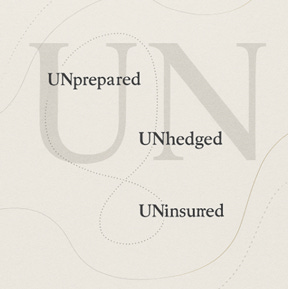
When we first introduced The UN, we called it the hidden half of every decision -- the UNseen, UNpriced, UNprepared side of risk.
This follow-up steps inside that terrain -- where the abstract starts to take shape.
UNprepared
A retailer built its empire on just-in-time inventory. Every system worked -- until a port strike stranded containers offshore. Shelves went bare, sales collapsed, and the “efficient” system revealed its fragility.
Other faces of UNprepared
• A company that never tests its backup systems until the blackout hits.
• A household with no savings, one paycheck away from crisis.
• An investor riding a bull market without a plan for when it stalls.
Preparedness isn’t paranoia -- it’s pricing reality.
The surprise will always come.
The only question is who pays the higher price.
UNhedged
A 60/40 investor thought they were diversified. Then 2022 hit. Stocks dropped. Bonds dropped. What was sold as balance moved in the same direction -- down.
Other faces of UNhedged
• A business with five “different” revenue lines -- all tied to the same consumer cycle.
• A farmer planting three crops, all vulnerable to the same drought.
• A supply chain spread across continents, but all reliant on the same shipping lane.
Hedging isn’t sprinkling variety on the same risk.
It’s holding what truly offsets it.
Otherwise, the “safety net” is just more rope from the same spool.
UNinsured
A family lived outside the flood zone, so they skipped the extra coverage. When the river rose, the map didn’t matter -- the water came anyway.
Other faces of UNinsured
• A small-business owner with no disability coverage -- one injury away from collapse.
• A portfolio chasing growth with zero cash buffer.
• A homeowner underinsured for replacement cost, holding the bag when prices rise.
Carrying small risks yourself makes sense -- like the deductible you can afford.
But carrying the big ones looks smart only until the bill arrives.
Some risks belong on someone else’s balance sheet.
The UN Map
These three are only the opening landmarks.
The terrain stretches further: UNconscious decisions, UNsaid truths, UNowned responsibilities.
Most avoid the map because it’s uncomfortable to look at.
We chart it anyway -- not to scare, to steer.
Seeing the UN was step one.
Mapping it is step two.
Next comes navigation -- turning awareness into action.